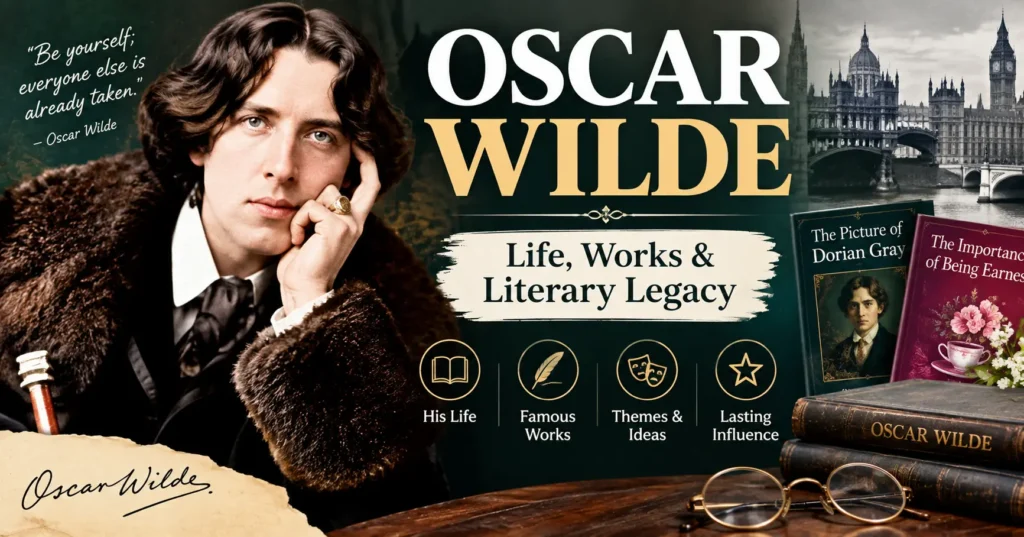
Few writers manage to outlive their century the way Oscar Wilde has. More than 125 years after his death, his one-liners circulate on social media, his plays fill theaters from London’s West End to small college stages in Ohio, and his novel still shows up on banned-book lists and required-reading syllabi in the same breath. That kind of staying power isn’t an accident of fame. It’s the result of a mind that understood language as a weapon, a shield, and a form of entertainment all at once. This article traces Wilde’s journey from a bookish boy in Dublin to the toast of London society, through the literary triumphs that made him famous, the scandal that destroyed his public life, and the strange afterlife that turned him into one of the most quoted writers in the English language.
Who Was Oscar Wilde?
Oscar Fingal O’Flahertie Wills Wilde was an Irish poet, novelist, essayist, and playwright who became the defining wit of late Victorian England. He wasn’t just a writer who happened to be clever; cleverness was his medium, almost as much as prose or verse. Wilde treated conversation itself as an art form, and he brought that same theatrical precision to everything he published, from drawing-room comedies to a single, unsettling novel about vanity and moral decay.
What set Wilde apart from his literary contemporaries was his refusal to separate the writer from the performance. He dressed the part, spoke in epigrams, and cultivated a public persona so vivid that people sometimes struggled to tell where the artist ended and the artwork began. That blurring was deliberate. Wilde believed that life should imitate art rather than the other way around, and he spent much of his career testing that idea in public, on stage, and eventually in a courtroom that had no patience for his philosophy.
Oscar Wilde Early Life and Education
Wilde was born in Dublin in 1854 into a household that valued intellect over convention. His father, Sir William Wilde, was a prominent ear and eye surgeon with a reputation for brilliance and eccentricity. His mother, Jane Wilde, wrote nationalist poetry under the pen name Speranza and hosted a literary salon that exposed young Oscar to poets, revolutionaries, and free thinkers before he was old enough to fully understand what they were arguing about. That household atmosphere, equal parts scholarly and theatrical, left a permanent mark on him.
He studied classics at Trinity College Dublin, where he distinguished himself academically and won a scholarship to Magdalen College, Oxford. Oxford is where Wilde truly found his voice. He fell under the influence of two very different thinkers: John Ruskin, who preached that art should serve moral and social good, and Walter Pater, who argued the opposite — that art existed for beauty’s sake alone, with no obligation to instruct anyone. Wilde absorbed both positions and, characteristically, refused to fully commit to either, instead building a personal philosophy that let him have it both ways depending on the room he was standing in. He graduated with top honors and left Oxford already known for his flamboyant dress, his sharp tongue, and his growing devotion to the aesthetic movement.
Oscar Wilde Rise as a Writer and Wit
After Oxford, Wilde moved to London with more ambition than income, and he made up the difference with sheer personality. He became a leading voice of Aestheticism, a movement built around the idea that art needed no justification beyond its own beauty. While plenty of critics considered this frivolous, Wilde turned it into a public spectacle, giving lectures, writing reviews, and dressing in a manner designed to be noticed, right down to velvet coats and a signature lily or sunflower.
His early literary output was uneven but ambitious. He published a collection of poems in 1881 that drew mixed reviews, and he toured the United States the following year delivering lectures on aesthetic philosophy to audiences who weren’t always sure whether to laugh with him or at him. Either reaction suited Wilde fine, since he understood something many writers of his era didn’t: notoriety builds an audience just as effectively as admiration does. By the mid-1880s, he was writing fairy tales, short stories, and criticism, sharpening the epigrammatic style that would soon make him one of the most quotable authors in English literary history. These years functioned as an apprenticeship, one where Wilde tested how far wit could carry serious ideas about beauty, morality, and hypocrisy before an audience stopped him.
Oscar Wilde Major Literary Works
Wilde’s reputation ultimately rests on a small but remarkably potent body of work, produced in a concentrated burst during the late 1880s and early 1890s. The Picture of Dorian Gray, published in 1890 and revised in 1891, remains his most discussed piece of fiction. The novel follows a young man who remains eternally youthful while a portrait of him absorbs the visible marks of his moral corruption. Beneath the surface plot, the novel functions as a meditation on vanity, the cost of a life devoted purely to pleasure, and the gap between public image and private truth, themes that Wilde understood intimately.
His theatrical works arrived in a remarkable rush. Lady Windermere’s Fan, A Woman of No Importance, and An Ideal Husband each combined social satire with sharp commentary on marriage, class, and reputation among the English upper crust. Then, in 1895, came The Importance of Being Earnest, widely regarded as his masterpiece and one of the finest comedies in the English language. Built almost entirely out of mistaken identities, double lives, and dialogue that turns social convention inside out, the play still gets produced constantly because its jokes about pretense and respectability haven’t aged the way most Victorian comedy has. Wilde also wrote essays, most notably “The Soul of Man Under Socialism,” along with poetry and the fairy tale collections he produced for his sons, proving his range extended well beyond stage comedy and gothic fiction.
Oscar Wilde Trial and Imprisonment
Wilde’s public triumph collapsed with startling speed in 1895. His relationship with Lord Alfred Douglas, known to friends as Bosie, had drawn the disapproval of Douglas’s father, the Marquess of Queensberry, who left a card at Wilde’s club accusing him of a homosexual offense in terms that were legally actionable at the time. Wilde, encouraged by Douglas and against the advice of several friends, sued Queensberry for libel. The decision backfired badly. Queensberry’s defense team uncovered evidence about Wilde’s private life that shifted the entire proceeding, and Wilde withdrew the suit before it collapsed entirely on him.
What followed was a criminal prosecution under British law, which at the time treated homosexual acts between men as a criminal offense under the Criminal Law Amendment Act of 1885. After a first trial ended without a verdict, a second trial convicted Wilde, and he was sentenced to two years of hard labor, a punishment that was severe even by the standards of Victorian criminal justice. He served his sentence at Pentonville, Wandsworth, and eventually Reading Gaol, where the physical conditions and isolation took a serious toll on his health. It’s worth understanding this episode within its historical context rather than through a modern lens alone: Wilde wasn’t merely a private citizen caught in a scandal, he was a prominent public figure whose downfall was seized upon by a press and public eager to see a celebrated wit humbled.
Oscar Wilde Final Years and Death
Wilde emerged from prison in 1897 financially ruined, socially exiled, and in fragile health. He left England for the European continent almost immediately and would never return. Adopting the name Sebastian Melmoth, partly for privacy and partly out of a weary sense of theater that never fully left him, he settled for periods in France and Italy, relying on the generosity of friends and a modest allowance from his estranged wife, Constance.
During this period he wrote The Ballad of Reading Gaol, a long narrative poem drawn directly from his prison experience and widely considered one of the most powerful literary responses to incarceration in English poetry. It was his last major work. His health, weakened by prison conditions and years of hardship, continued to decline, and he died in Paris in November 1900 from complications related to meningitis, reportedly following an ear infection that had never fully healed. He was buried in Paris, and his remains were later moved to Père Lachaise Cemetery, where his tomb, designed by sculptor Jacob Epstein, remains one of the most visited literary graves in the world.
Oscar Wilde Lasting Literary Legacy
Wilde’s reputation underwent a slow but steady rehabilitation over the twentieth century, as attitudes toward sexuality shifted and his literary achievements were reassessed on their own merits rather than through the lens of scandal. Today he’s recognized not only as a brilliant comic dramatist but as a serious moral thinker who used humor as a delivery system for uncomfortable truths about hypocrisy, class, and identity. Academic interest in his work has only grown, with scholars examining everything from his queer identity to his critique of Victorian respectability. The study of influential people often extends beyond their achievements alone, whether examining Wilde’s literary contributions or Jesse Jackson’s public life and legacy in social and political history.
His influence extends well past the classroom. The Importance of Being Earnest remains one of the most frequently staged plays in the English-speaking world, and The Picture of Dorian Gray continues to inspire film adaptations, stage versions, and countless cultural references. His epigrams circulate constantly online, often detached from their original context but still carrying his unmistakable rhythm and bite. Playwrights, novelists, and screenwriters continue to borrow his techniques: the reversal of expectation, the villain who speaks the most honest lines in the room, the comedy that turns serious the moment you stop laughing. Few writers manage to be both a historical figure and a living presence in popular culture at once, but Wilde has held that position for over a century. Similar lasting influence can be seen in other cultural figures, including Patrick Swayze’s lasting influence on popular culture, whose work continues to connect with new generations.
Conclusion
Oscar Wilde life reads almost like one of his own plays: a brilliant rise, a devastating reversal, and a final act that reveals more truth than the comedy ever let on. He gave the world some of its sharpest social satire, one of its most unsettling novels, and a personal story that still raises difficult questions about art, identity, and judgment. What keeps readers returning to him isn’t nostalgia. It’s the sense that Wilde saw through the performances people put on for one another, and had the nerve, and the wit, to say so out loud.