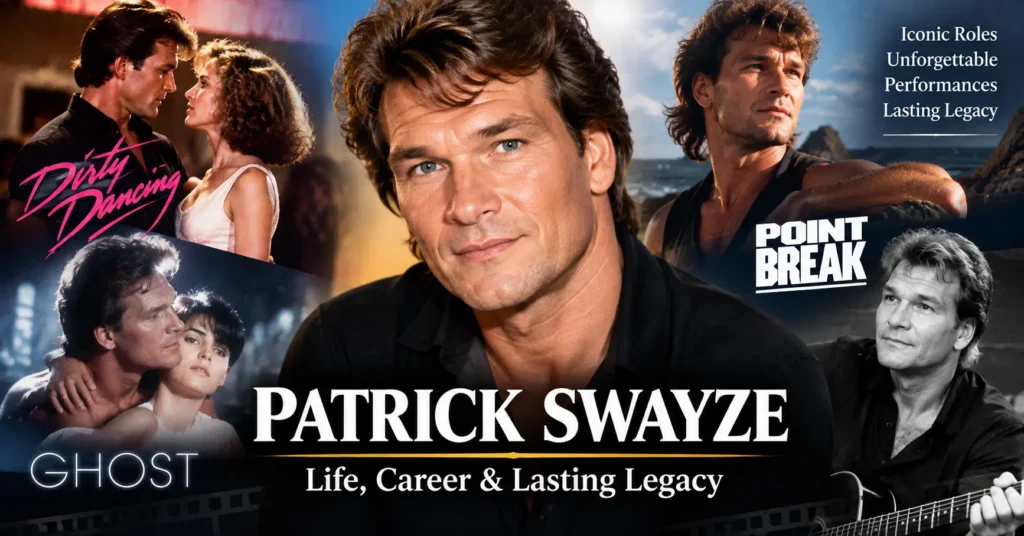
There’s a particular kind of quiet that falls over a room when “She’s Like the Wind” starts playing, or when someone mentions a pottery wheel, or utters the words “nobody puts Baby in a corner.” That’s the strange, lasting power Patrick Swayze still holds over audiences, more than a decade after his passing. He wasn’t just another leading man from the 1980s action-romance boom. He was something rarer: an actor who could throw a punch in one film and execute a flawless dance lift in the next, without either performance feeling like a stretch.
This article takes a closer look at the man behind those performances — where he came from, how he built a career that refused to be boxed into one genre, and why his name still resonates with people who weren’t even born when “Dirty Dancing” hit theaters. We’ll walk through his early years in Texas, the breakout roles that made him a household name, his lesser-known ventures into music and television, his marriage to Lisa Niemi, and the illness that ultimately took his life far too soon. Along the way, it’s worth remembering that Swayze’s story isn’t just about fame — it’s about resilience, discipline, and a genuine love for his craft that audiences could feel through the screen.
Who Was Patrick Swayze?
Patrick Wayne Swayze was an American actor, dancer, and occasional singer-songwriter whose career spanned roughly four decades, from small television appearances in the late 1970s to his final film role shortly before his death in 2009. He’s remembered primarily for a string of films in the mid-to-late 1980s and early 1990s that turned him into one of the most recognizable faces in American cinema — a status that owed as much to his physical training as a dancer as it did to any traditional acting pedigree.
What set Swayze apart from many of his contemporaries was the sheer range he brought to his roles. He could play a working-class bouncer with a philosophy degree in “Road House,” a grieving, protective ghost in “Ghost,” and a tender, working-class dance instructor in “Dirty Dancing” — three wildly different characters that somehow all felt authentically him. That versatility, combined with a genuine, unforced charisma, is a big part of why his films continue to be rediscovered by new generations of viewers, often introduced to his work by parents or grandparents eager to share a piece of their own youth.
Patrick Swayze’s Early Life and Path to Acting
Swayze was born on August 18, 1952, in Houston, Texas, and grew up in a household where movement and performance weren’t hobbies — they were practically the family business. His mother, Patsy Swayze, was a respected choreographer and dance instructor who ran her own studio, and young Patrick spent much of his childhood immersed in ballet, tap, and gymnastics rather than football fields or arcades, which made him something of an outlier among his Texas peers.
That early, rigorous dance training turned out to be the foundation of his entire career, even though it wasn’t always easy for him growing up. Being a boy who studied ballet in a conservative Texan environment invited plenty of teasing, but Swayze stuck with it, eventually studying at the Harkness Ballet and Joffrey Ballet schools in New York. A knee injury sidelined his ambitions of a full-time dance career, which nudged him toward acting instead. He landed small television roles through the late 1970s, including appearances in “MAS*H” and “The Renegades,” before catching his first real break with the 1983 film “The Outsiders,” where he appeared alongside a now-legendary young cast that included Tom Cruise, Rob Lowe, and Emilio Estevez. It wasn’t a starring role, but it put him on the radar of casting directors who were beginning to notice his unusual combination of physicality and warmth.
Patrick Swayze’s Breakout Roles and Iconic Films
If there’s one film that defines Patrick Swayze’s legacy in the popular imagination, it’s “Dirty Dancing” (1987). Made on a modest budget and initially expected to be a minor summer release, the film became a cultural phenomenon, largely on the strength of the chemistry between Swayze’s Johnny Castle and Jennifer Grey’s Baby. His dance background wasn’t incidental to the role — it was essential, allowing him to perform the film’s now-iconic choreography himself, including that final lift, which has been imitated and parodied countless times since. The film’s soundtrack, featuring “(I’ve Had) The Time of My Life,” became inseparable from his public image for the rest of his life.
Just three years later, Swayze proved he was far more than a dance-movie leading man when he starred in “Ghost” (1990), playing Sam Wheat, a murdered man trying to protect his girlfriend from beyond the grave. The film’s pottery-wheel scene, set to “Unchained Melody,” became one of the most referenced romantic moments in film history, and the movie earned Demi Moore’s co-star Whoopi Goldberg an Academy Award while cementing Swayze’s status as a genuine box-office draw rather than a one-hit sensation. In between and around these two career-defining roles, he took on “Road House” (1989), a film that has since become something of a cult classic for its blend of barroom brawling and unexpected philosophical dialogue, and “Point Break” (1991), where he played the enigmatic surfer-bank robber Bodhi opposite Keanu Reeves.
Patrick Swayze’s Career Beyond Film
While his film work understandably overshadows everything else, Swayze’s creative output extended well beyond the multiplex. He co-wrote and performed “She’s Like the Wind” for the “Dirty Dancing” soundtrack, a song that reached the top five on the Billboard Hot 100 and surprised many who hadn’t realized he was a genuinely capable vocalist. Music remained a quiet passion throughout his life, and he continued writing songs even during periods when film offers slowed down.
Television also played a bigger role in his career than casual fans often remember. In 2006, he starred in the A&E miniseries “Jesse” and later took on the lead role in the drama series “The Beast” (2009), which turned out to be one of his final major projects, filmed while he was already battling serious illness. Long before that, in 1985, he had appeared in the acclaimed miniseries “North and South,” which introduced him to television audiences in a Civil War drama that ran for multiple seasons and remains fondly remembered by fans of the genre. He also returned to his dance roots periodically, choreographing and consulting on projects, a reminder that acting was never his only skill — it was simply the one that made him famous.
Patrick Swayze’s Personal Life and Relationship With Lisa Niemi
Swayze’s marriage to Lisa Niemi is one of the more genuinely touching love stories to come out of Hollywood, if only because of how ordinary its beginnings were. The two met when Niemi, then a young dancer, was a student at his mother’s dance studio in Houston. They married in 1975, when Swayze was just 22, and remained together until his death in 2009 — a rarity in an industry known for short-lived unions.
Niemi wasn’t simply a spouse waiting in the wings; she was a trained dancer and choreographer in her own right, and the two frequently collaborated professionally, including on projects where she contributed choreography. Their relationship weathered the normal strains of fame, long shooting schedules, and the demands of two creative careers, and by all public accounts it was built on a shared language of movement and mutual respect that predated his stardom entirely. When Swayze’s illness became public, Niemi remained a constant, visible presence by his side, and her devotion during his final years became, for many fans, an inseparable part of how his story is remembered.
Patrick Swayze’s Cancer Battle and Passing
In early 2008, Patrick Swayze was diagnosed with stage IV pancreatic cancer, one of the most aggressive and difficult-to-treat forms of the disease. True to the discipline that had defined his dance and acting career, he approached treatment with remarkable determination, continuing to work on “The Beast” throughout much of his illness rather than stepping away from the profession he loved. He spoke publicly about his diagnosis with unusual candor, giving interviews that discussed both the physical toll of chemotherapy and his refusal to simply wait for the disease to take its course.
Swayze passed away on September 14, 2009, at his home in Los Angeles, with Lisa Niemi by his side, at the age of 57. His death prompted an outpouring of tributes from across the entertainment industry, with former co-stars, directors, and fans reflecting on both his talent and the grace with which he faced his final illness. Rather than retreating from public life, he had chosen to share his experience, and that openness left a lasting impression on how his final chapter is remembered — not as a quiet fade, but as one more example of the resilience that had defined him from childhood.
Patrick Swayze’s Legacy in Hollywood
More than a decade on, Patrick Swayze films remain in constant rotation on cable networks and streaming platforms, introduced to new audiences who often have no memory of his passing. “Dirty Dancing” in particular has taken on a life of its own, spawning stage adaptations, anniversary screenings, and an entire cottage industry of dance schools using its choreography as inspiration. Few films from that era have aged into cultural touchstones quite so completely.
His legacy also lives on in how actors and choreographers speak about the physicality he brought to film — a reminder that “action hero” and “dancer” were never mutually exclusive categories, whatever industry conventions suggested at the time. Younger performers with dance backgrounds crossing into film often cite him, directly or indirectly, as proof that such a transition can work. Beyond the industry, Swayze’s legacy is deeply personal for millions of fans who associate his films with specific memories: a first date, a mother-daughter movie night, a wedding song. That kind of emotional imprint is rare, and it’s a large part of why tribute articles, fan pages, and retrospectives about him continue to draw readers years after his death.
Conclusion
Patrick Swayze career defies easy categorization, and that’s precisely what makes it so enduring. He was a trained dancer who became an action star, a romantic lead who could just as easily play tough and unyielding, and a man who faced his final illness with the same discipline he brought to every role he ever took on. From the dance floors of “Dirty Dancing” to the emotional depths of “Ghost,” his work continues to find new audiences, proof that genuine talent and warmth on screen don’t fade with time. Decades from now, it’s easy to imagine another generation discovering him for the first time, and falling for that same unmistakable blend of toughness and tenderness that made him unforgettable in the first place.