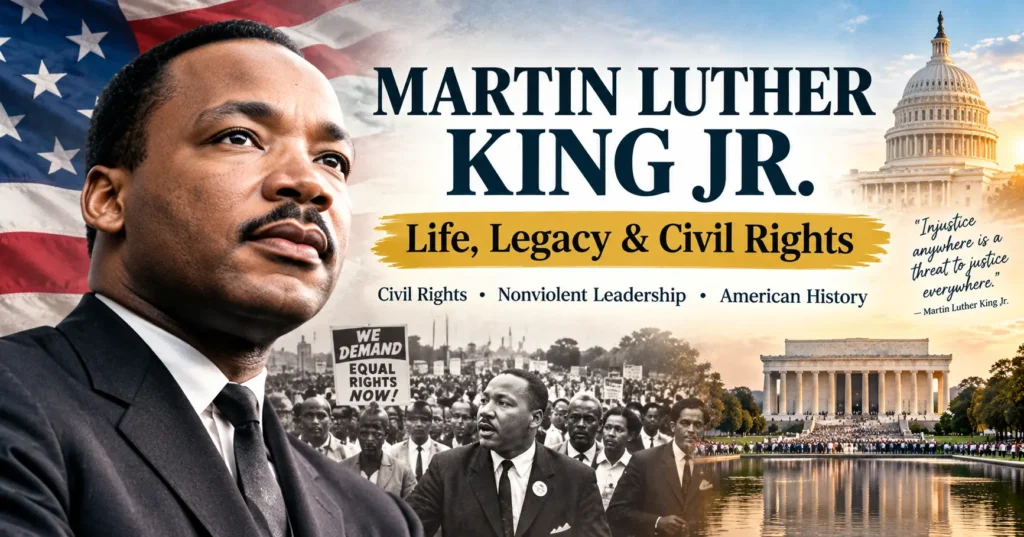
Few names in American history carry the weight that Martin Luther King Jr.’s does. Nearly six decades after his death, his words still surface in graduation speeches, his image still appears on murals from Atlanta to Los Angeles, and his approach to social change still shapes how activists think about protest today. That kind of staying power is rare, and it raises a fair question: what exactly did one man accomplish in a public life that spanned barely thirteen years?
This article traces that story from the beginning. It looks at the household that shaped him, the education that sharpened his thinking, and the movement that turned a young Baptist preacher into the most recognized voice of the civil rights era. It also examines the parts of his career that get less attention in classroom summaries — his fight against poverty, his opposition to the Vietnam War, and the political isolation that followed. By the end, the goal is a fuller picture of who King was, not just the polished version that appears on a postage stamp.
Who Was Martin Luther King Jr.?
Martin Luther King Jr. was a Baptist minister who became the most visible leader of the American civil rights movement between 1955 and 1968. He built his public life around a simple but demanding idea: that nonviolent resistance could dismantle legal segregation and force a reluctant nation to live up to its own founding promises. He was not a politician and never held elected office, yet he negotiated directly with presidents, shaped federal legislation through sheer public pressure, and became a household name across the world.
What set King apart from many of his contemporaries was his ability to combine the language of the pulpit with the strategy of a organizer. He could quote scripture and Gandhi in the same breath, then translate both into a workable plan for a bus boycott or a voter registration drive. That combination of moral conviction and practical strategy is part of why his leadership still gets studied in fields well beyond history, including law, theology, and organizational psychology.
Martin Luther King Jr.’s Early Life and Education
King was born on January 15, 1929, in Atlanta, Georgia, into a family with deep roots in the Black church. His father, Martin Luther King Sr., served as pastor of Ebenezer Baptist Church, and his mother, Alberta Williams King, came from a family already active in local civic life. Growing up in the Sweet Auburn district, a thriving Black business and cultural hub, King experienced both a supportive community and the daily humiliations of segregation, including a childhood incident in which a white friend’s parents forbade the boys from playing together once they were old enough for “separate” schools.
He entered Morehouse College at just fifteen, an unusually young age even by the standards of the time, and there he came under the influence of Benjamin Mays, the college’s president, who encouraged him to see the ministry as a vehicle for social change rather than a retreat from it. King went on to Crozer Theological Seminary in Pennsylvania and later earned his doctorate in systematic theology from Boston University in 1955. It was in Boston that he met Coretta Scott, a music student with her own history of activism, whom he married in 1953. This academic path matters because it explains why King’s later sermons and speeches carried the layered influence of theologians, philosophers, and political thinkers rather than reading as simple appeals to emotion.
Martin Luther King Jr.’s Role in the Civil Rights Movement
King’s public career effectively began in Montgomery, Alabama, where he had taken his first pastorate at Dexter Avenue Baptist Church. When Rosa Parks was arrested in December 1955 for refusing to give up her bus seat, local organizers asked the twenty-six-year-old minister to lead the resulting boycott, partly because he was new to the city and had few enemies yet. The Montgomery Bus Boycott lasted 381 days and ended only after the Supreme Court ruled bus segregation unconstitutional. It also introduced King to the national press and gave him his first real test as a strategist under pressure, including a period when his home was bombed while his wife and infant daughter were inside.
From that foundation, King helped found the Southern Christian Leadership Conference in 1957, an organization built specifically to coordinate nonviolent protest campaigns across the South using the moral authority of Black churches. King’s approach to organized activism influenced later generations of civil rights leaders, including Jesse Jackson’s civil rights leadership and activism, which continued many conversations around equality, economic opportunity, and social justice. Over the following years, he refined a method that drew heavily on Mohandas Gandhi’s example: provoke a confrontation with unjust laws through peaceful means, accept arrest and violence without retaliation, and let the resulting public outrage do the political work that lawsuits alone could not. This approach played out in Birmingham in 1963, where images of police using fire hoses and dogs on peaceful demonstrators, including children, shocked much of the country and helped push the Kennedy administration toward what would become the Civil Rights Act.
The March on Washington and the I Have a Dream Speech
On August 28, 1963, more than 250,000 people gathered at the Lincoln Memorial for the March on Washington for Jobs and Freedom, a demonstration organized jointly by King and other civil rights leaders including A. Philip Randolph and Bayard Rustin. The march was designed to pressure Congress on pending civil rights legislation, and it succeeded in becoming the largest political gathering the capital had seen to that point. King spoke last, and his address that afternoon has since become the single most recognized speech in American history.
Rather than reciting the speech’s specific lines, it is worth noting what made it work rhetorically. King began with prepared remarks tied closely to the day’s political demands, then shifted into an improvised, cadence-driven vision of a future where character mattered more than skin color, drawing on gospel rhythms familiar to anyone who had sat in a Black Baptist church. That blend of concrete grievance and soaring hope is part of why the speech transcended its moment. It helped build momentum for the Civil Rights Act of 1964, and later that same year King received the Nobel Peace Prize, becoming at thirty-five one of the youngest recipients in the prize’s history, an honor he used to reinforce his commitment to nonviolence even as some younger activists began pushing toward more confrontational tactics.
Martin Luther King Jr.’s Later Activism and Challenges
The years after 1965 are often underrepresented in popular retellings, but they show a King who was willing to expand his focus even when it cost him public support. He turned his attention northward to Chicago, confronting housing discrimination and economic segregation that proved far harder to dislodge than the legally codified racism of the South. Around the same time, he launched the Poor People’s Campaign, arguing that legal equality meant little without economic opportunity, and calling for a genuine assault on poverty affecting Americans of every race.
King also broke publicly with the Johnson administration over the Vietnam War, delivering a 1967 speech at Riverside Church in New York that linked militarism, racism, and poverty as interconnected failures of American society. The speech cost him allies in the press and in government, and polling at the time showed his public approval had dropped sharply from its 1963 peak. Far from softening his positions to regain favor, King kept organizing, traveling to Memphis in early 1968 to support striking sanitation workers demanding fair wages and safer working conditions, a cause that placed him squarely back in the kind of direct, local labor dispute where his career had started more than a decade earlier.
Martin Luther King Jr.’s Assassination
On April 4, 1968, Martin Luther King Jr. was shot while standing on the balcony of the Lorraine Motel in Memphis, Tennessee, where he was staying during the sanitation workers’ campaign. He was pronounced dead at St. Joseph’s Hospital shortly afterward, at the age of thirty-nine. James Earl Ray was arrested in London two months later and pleaded guilty to the killing, though questions about the full circumstances of the assassination have persisted among historians and members of King’s own family in the decades since.
News of his death set off grief and unrest in more than a hundred American cities, underscoring how deeply the loss registered across racial and generational lines. Congress, which had stalled on fair housing legislation for years, passed the Civil Rights Act of 1968 within a week of his death, a grim illustration of how much political urgency his assassination generated even as it silenced the man who had pushed hardest for that very law.
Martin Luther King Jr.’s Legacy Today
King’s influence did not end with his death, and in some ways it has grown more visible over time. Like many historical figures who shaped American history, King’s legacy continues to be studied through debates about culture, identity, and social change. Congress established Martin Luther King Jr. Day as a federal holiday in 1983, though individual states took varying lengths of time to formally observe it, with South Carolina becoming the last to do so in 2000. His birthplace, church, and gravesite in Atlanta now form a National Historical Park, drawing visitors who want to understand the movement’s roots rather than just its highlight reel.
Beyond monuments and holidays, King’s specific model of organized, disciplined nonviolent protest has informed movements well outside the United States, including anti-apartheid organizing in South Africa and pro-democracy demonstrations in various parts of Asia and Eastern Europe. Within American life, his insistence on linking racial justice to economic fairness continues to shape debates that outlast any single news cycle. Scholars, clergy, and civic leaders across the political spectrum still cite him, sometimes selectively, which is itself a testament to how central his framing of justice and citizenship has become to American public language.
Conclusion
Martin Luther King Jr.’s life resists easy summary because he was never just one thing. He was a preacher who became a strategist, a Southern pastor who ended up debating foreign policy, and a symbol of hope who spent his final years increasingly at odds with public opinion. What ties those pieces together is a consistent refusal to separate moral conviction from practical action. Decades later, his example still asks a difficult question of anyone who studies it: not just what do you believe, but what are you willing to organize, risk, and sustain in service of that belief.