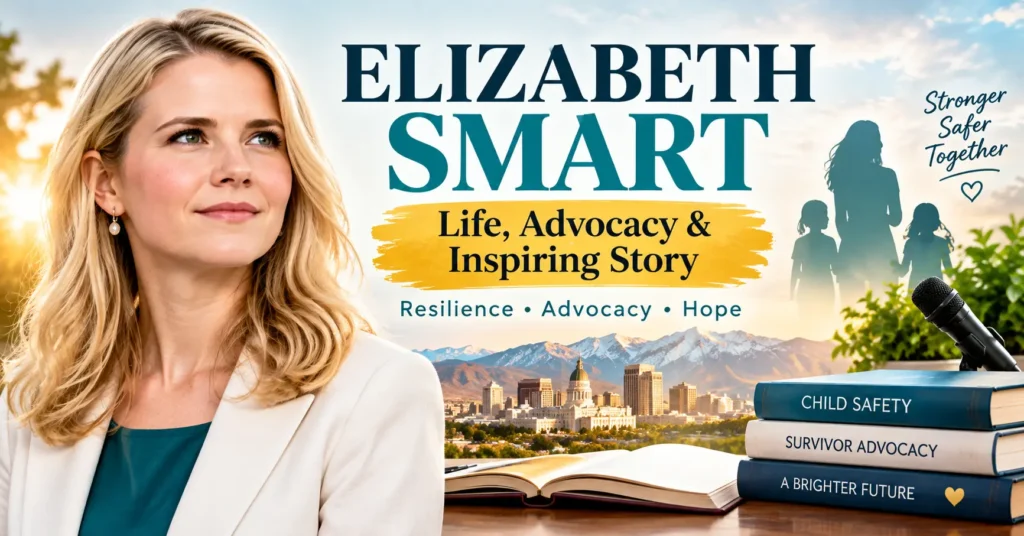
Elizabeth Smart is one of the most recognizable names in American child-safety advocacy, but she is far more than the headlines that once surrounded her. More than two decades after she was found alive following a widely publicized kidnapping, Smart has built a life defined by purpose: as a wife, a mother of three, an author, a public speaker, and the founder of an organization dedicated to preventing sexual violence and supporting survivors. Her story continues to resonate not because of what happened to her as a teenager, but because of what she has chosen to do with her voice since. This article offers a respectful overview of the Elizabeth Smart story, her case, her rescue, and the advocacy work that now defines her public life.
Who Is Elizabeth Smart?
Elizabeth Ann Smart was born on November 3, 1987, in Salt Lake City, Utah. She grew up in a close-knit family and studied music at Brigham Young University, where she trained as a harpist. Today, Smart is known as a child safety advocate, author, and commentator, having contributed to national media coverage of missing-persons cases. She is married to Matthew Gilmour, and the couple are raising three children in Utah.
While the Elizabeth Smart kidnapping case brought her into the national spotlight as a teenager, she has consistently pushed back against being defined solely by that experience. Instead, she has used her platform to build the Elizabeth Smart Foundation, publish several books, host a podcast, and speak publicly on behalf of survivors of abduction, sexual assault, and exploitation across the country.
A Brief, Respectful Overview of Her Case
On June 5, 2002, at age 14, Elizabeth Smart was abducted from her family’s home in Salt Lake City. She was taken by Brian David Mitchell, with his wife, Wanda Barzee, later identified as an accomplice. Smart was held captive for approximately nine months, during which she endured captivity, abuse, and mistreatment. Out of respect for her privacy and in keeping with her own public statements, this article does not detail the specifics of what she experienced during that period; Smart herself has chosen, in her own writing and interviews, what to share and how.
The case drew intense national and international media attention, becoming one of the most closely followed child abduction cases in United States history. Her family’s search efforts, along with law enforcement’s investigation, kept the case in the public eye for months.
Her Rescue and Its Aftermath
On March 12, 2003, Elizabeth Smart was recognized by members of the public in Sandy, Utah, alongside Mitchell and Barzee, and was safely returned to her family. Her rescue was met with widespread relief and became a defining moment in American missing-persons coverage, credited in part with reinforcing public support for the AMBER Alert system.
In the years that followed, Smart testified in court proceedings against her captors. Brian David Mitchell was convicted in 2010 and sentenced to life in prison. Wanda Barzee pleaded guilty to related charges; she was later released from custody in 2018 after completing her federal sentence, a decision that itself drew public attention and discussion, as reported by national news outlets at the time. Smart has spoken publicly about the difficulty of watching that release and about the ongoing importance of supporting crime victims through the legal process.
From Survivor to Advocate
Rather than retreating from public life, Smart made a deliberate choice to speak out. She has explained in interviews that after so much information about her case became public through the criminal trial, she wanted her experience to serve a larger purpose. That decision marked the beginning of her advocacy career. Many public figures have used their personal experiences and platforms to support social causes, including Jesse Jackson’s activism and public advocacy in areas related to civil rights and community empowerment.
Smart became involved in supporting legislation aimed at protecting children, including advocacy connected to the national AMBER Alert system and the Adam Walsh Child Protection and Safety Act. She has testified before lawmakers, worked with law enforcement agencies, and partnered with other high-profile advocates in the missing-children space, including John Walsh, to push for stronger protections against child exploitation.
Central to Smart’s advocacy is a focus on believing and supporting survivors rather than centering public narratives on the details of trauma itself. She has said that after her own return, she did not know of others who had experienced kidnapping or captivity, and that this isolation shaped her later commitment to making sure other survivors feel less alone.
The Elizabeth Smart Foundation
In 2011, Smart founded the Elizabeth Smart Foundation, an organization dedicated to fighting sexual violence through prevention, education, and survivor support. In 2022, the foundation became part of the Malouf Foundation, a Utah-based nonprofit, allowing it to expand its reach while continuing its core mission under Smart’s continued involvement and public leadership.
The foundation’s programs include Smart Defense, a self-defense training course designed for women and girls, taught in multiple locations around the country. The organization also runs a Survivor Support Fund, which provides direct financial assistance to adult survivors of sexual violence for needs such as therapy, legal support, and housing. Another initiative, called We Believe You, focuses on educating communities about how to respond when someone discloses abuse, with an emphasis on believing and supporting survivors rather than questioning them.
Smart also hosts Smart Talks, a podcast in which she speaks with therapists, survivors, and experts in the anti-violence field about recovery, resilience, and prevention. Through these projects, the Elizabeth Smart Foundation has positioned itself as a survivor-led organization, with Smart directly shaping its priorities and public messaging.
Elizabeth Smart’s Books
Smart has written about her experiences and her broader philosophy of healing across three books. Her first, a memoir titled “My Story,” was published in 2013 and gave her a chance to describe her experience and recovery in her own words. She followed with “Where There’s Hope” in 2018, which broadened her focus to include the stories of other survivors and safety advocates.
Her most recent book, “Detours: Hope & Growth After Life’s Hardest Turns,” was published in December 2025. Rather than centering solely on her own captivity, the book uses the metaphor of a road trip interrupted by an unexpected detour to talk more broadly about resilience after hardship. Smart has described organizing the book around several “rest stops,” representing stages many people move through when processing difficult life changes, such as grieving what was lost, adapting to new circumstances, building connection with others, and redefining what comes next. Reviewers have noted that the book functions as part memoir and part guide to healing, written in an approachable, conversational tone.
Elizabeth Smart Today
Today, Smart continues to balance her advocacy work with family life and public speaking engagements across the country. She has served as a contributor and commentator for national media outlets, often providing context and perspective when missing-persons cases make headlines. She continues to speak at events supporting survivors of trafficking and sexual violence, including recent appearances with other advocacy organizations working to combat child exploitation.
Smart has also participated in documentary projects revisiting her case, generally with an emphasis on how the story can help other families and survivors rather than simply retelling the events of 2002 and 2003. She has said she remains supportive of projects that handle her story responsibly and that serve an educational or awareness-raising purpose.
Each year, the anniversary of her rescue on March 12 continues to draw public attention, and Smart has used the occasion to reflect publicly on resilience and hope rather than solely on what she endured. She has described the date as a reminder that difficult circumstances do not have to define a person’s future.
Why Her Story Continues to Matter
Elizabeth Smart’s case remains a significant point of reference in conversations about child safety, missing-persons response, and public awareness campaigns like the AMBER Alert system. But her ongoing relevance owes as much to her advocacy as it does to the case itself. By founding an organization, writing books, and speaking publicly for more than a decade, she has helped shift public conversation toward supporting survivors and preventing future harm, rather than focusing solely on individual cases of tragedy.
Her work also reflects a broader shift in how survivors of high-profile crimes are able to reclaim their own narratives. Smart has repeatedly emphasized that survivors deserve to be believed, supported, and given the space to define their own recovery on their own terms, a message that now sits at the center of her foundation’s mission.
Conclusion
Elizabeth Smart’s life today is shaped far more by her advocacy, her family, and her writing than by the crime committed against her as a child. Her foundation, her books, and her public speaking all point toward the same goal: helping other survivors find support and helping communities prevent future harm. For readers encountering her story for the first time, or revisiting it years later, the throughline is not victimhood, but the deliberate, ongoing work of turning a painful chapter into a platform for change.