Few entertainers have managed to stay part of the public conversation for as long as Dick Van Dyke. He built his name in the golden age of television and film musicals in the 1960s, and remarkably, he was still appearing on screen and talking to reporters about his life well into his hundredth year. That kind of longevity, both in career and in life itself, makes him one of the most enduring figures in American entertainment history.
This article traces his path from a childhood in the Midwest to Broadway stardom, television history, and one of the most beloved family films ever made, before looking at the later chapters of his career and the legacy he has built along the way. Rather than treating him as a nostalgic relic of an earlier era, the aim is to show how a performer’s steady, decades-long presence can shape popular culture in ways that a single hit rarely can.
Who Is Dick Van Dyke?
Dick Van Dyke is an American actor, comedian, singer, and dancer whose career stretches back to the late 1940s. He is best known for starring in the beloved sitcom that bears his name and for his role as Bert the chimney sweep in the 1964 Disney musical Mary Poppins, a performance that introduced him to generations of families and remains one of the most recognizable roles in film history.
What distinguishes Van Dyke from many performers of his generation is the sheer range of his career. He has worked in theater, television, and film, moved comfortably between comedy and drama, and continued taking on new projects long after most of his peers had retired. His physical comedy, rooted in vaudeville-style pratfalls and dance, gave his performances an energy that felt distinct even among the talented ensembles he often worked alongside.
Dick Van Dyke’s Early Life and Education
Richard Wayne Van Dyke was born on December 13, 1925, in West Plains, Missouri, and grew up primarily in Danville, Illinois. He was drawn to performing from a young age, entertaining classmates and later working odd jobs that let him experiment with comedic timing and radio announcing. Rather than pursuing a traditional college path, he leaned into performance early, developing skills that would later define his stage and screen work.
His path took a detour during World War II, when he served in the United States Army Air Forces, ultimately working with the Armed Forces Radio Service rather than in combat. That posting gave him further experience with broadcasting and performance in front of an audience, skills he carried into civilian life. After his service ended, he partnered with a friend for a pantomime comedy act that toured nightclubs and television variety shows, giving him his first real taste of professional show business and the discipline it required.
Dick Van Dyke’s Rise Through Broadway and Early Television
Van Dyke’s breakthrough came on Broadway, where he starred as Albert Peterson in the 1960 musical Bye Bye Birdie, a role that showcased his singing, dancing, and comic timing in equal measure. The performance earned him a Tony Award and marked him as a rising talent capable of carrying a major production, not just supporting one. It also caught the attention of television producers who were looking for a lead who could handle both physical comedy and warm, relatable everyman charm.
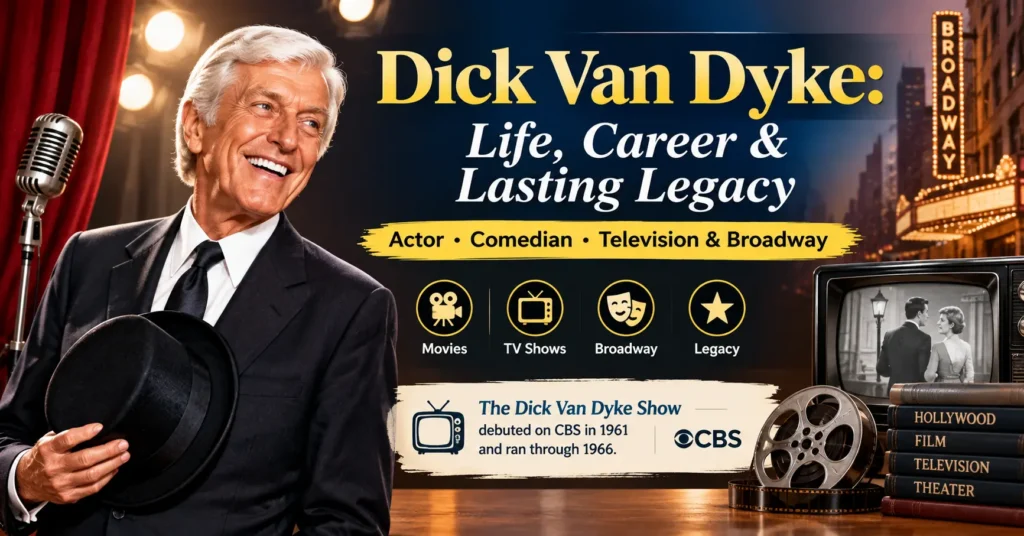
That attention led directly to The Dick Van Dyke Show, which premiered on CBS in 1961 and ran until 1966. The series, built around a television comedy writer navigating both his career and home life, became one of the defining sitcoms of its era, praised for its sharp writing and Van Dyke’s ability to turn ordinary domestic moments into memorable physical comedy, including the show’s famous opening sequence built around him tripping over an ottoman. The series earned him multiple Emmy Awards and cemented his reputation as one of television’s most skilled comedic performers, setting the stage for a leap into film just as his television fame was peaking.
Mary Poppins and Dick Van Dyke’s Film Career
In 1964, Van Dyke starred alongside Julie Andrews in Mary Poppins, playing Bert, a jack-of-all-trades chimney sweep who guides the audience through the film’s blend of music, dance, and fantasy. The role required him to master an English accent, which drew mixed reviews from critics at the time, but the performance’s warmth and physical energy made it enduringly popular with audiences, and the film became a defining piece of Disney’s live-action legacy. His work in the movie’s dance sequences, blending traditional choreography with then-groundbreaking effects, remains one of the most fondly remembered parts of his career.
Van Dyke continued working steadily in film through the following decades, including a starring role in the 1968 musical Chitty Chitty Bang Bang, which further established him as a reliable lead in family-oriented musical entertainment. While he never fully abandoned television, his film work through the 1960s solidified his reputation as a performer who could headline a major studio production, and it introduced his particular style of gentle, physical comedy to an international audience far beyond the reach of his earlier television work.
Dick Van Dyke’s Later Career and Personal Challenges
Van Dyke’s career did not slow down after his early success. In the 1990s, he found a new audience playing a physician and amateur detective on the television series Diagnosis: Murder, a role that ran for eight seasons and introduced him to a generation that had grown up without his earlier work. He continued taking on television and film roles well into his eighties and nineties, including a memorable guest appearance on the soap opera Days of Our Lives that made him the oldest performer ever to win a Daytime Emmy Award at the time.
Alongside his professional achievements, Van Dyke has been open about personal struggles, including a long battle with alcohol that he has discussed publicly as part of encouraging others facing similar issues. His willingness to speak candidly about that period of his life, rather than avoid it, added a layer of honesty to his public image that set him apart from the polished nostalgia often associated with performers of his era. He has also remained visibly engaged with health and fitness well into old age, frequently crediting a consistent exercise routine for his continued mobility and energy.
Dick Van Dyke’s Legacy Today
Van Dyke’s influence on American entertainment is difficult to overstate, both for the specific works he is remembered for and for the sheer example of longevity he represents. The Dick Van Dyke Show is still studied as a model of well-constructed television comedy, and Mary Poppins remains a staple of family viewing more than sixty years after its release, introduced to new generations through both nostalgia and Disney’s continued promotion of its classic catalog.
Beyond his individual roles, Van Dyke has become something of a cultural symbol for aging with energy and purpose. Reaching his hundredth birthday in December 2025 while still active publicly, still exercising, and still willing to talk with reporters about his outlook on life turned him into a figure people look to for something beyond entertainment history, namely a model of resilience and continued engagement with the world. Awards bodies and entertainment organizations have continued to honor him with lifetime achievement recognitions, reflecting an industry-wide acknowledgment that his contributions span not just individual performances but the shape of American television and film comedy across multiple decades.
Conclusion
Dick Van Dyke’s career traces a path from small-town Missouri to Broadway, network television, and one of Hollywood’s most beloved musicals, sustained by a work ethic and physical comic energy that never seemed to fade with time. Few performers manage even one defining role in a lifetime, and fewer still remain active and publicly engaged decades after their peak years of fame. His story is less about a single triumphant moment than about consistency across an extraordinarily long career, and that steady presence, still unfolding well past his hundredth year, is what continues to make him a genuinely singular figure in American entertainment.