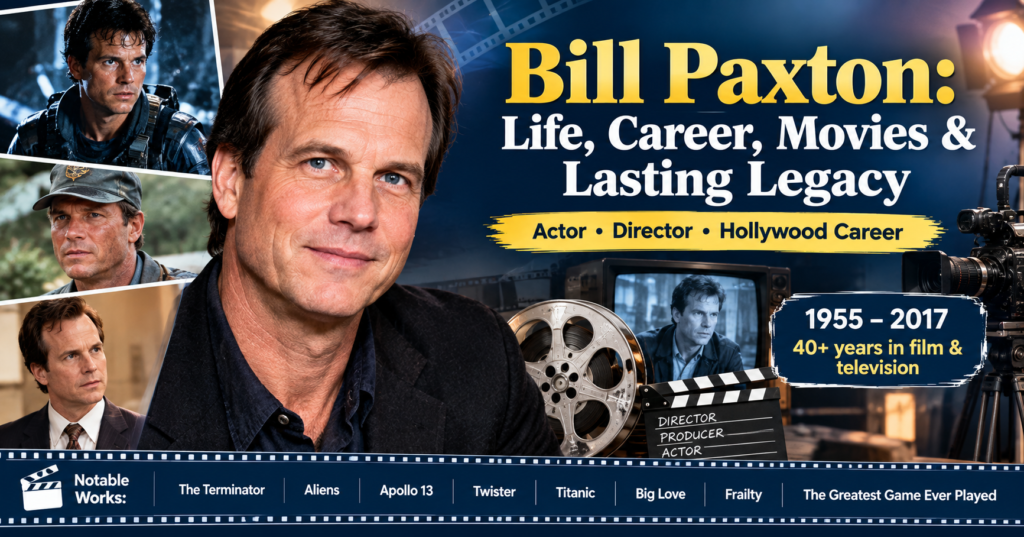
Some actors build careers by becoming unmistakably themselves in every role. Bill Paxton built his by disappearing into ordinary men caught in extraordinary circumstances — a rattled space engineer, a nervous marine, a small-town polygamist, a ship’s captain watching history sink beneath him. Across four decades, he became one of Hollywood’s most reliable presences without ever quite becoming a conventional leading man, and that in-between quality is exactly why his work has aged so well.
This article traces Paxton’s path from a childhood in Fort Worth, Texas, through his early years working behind the scenes in Hollywood, his breakout supporting roles in the 1980s, and the string of blockbuster and prestige projects that defined his career in the 1990s and 2000s. It also looks at his work as a director, his television success later in life, and the legacy he left behind after his sudden death in 2017.
Who Was Bill Paxton?
Bill Paxton was an American actor, director, and producer best known for his work in major studio films of the 1990s and for character-driven television roles later in his career. He had a rare ability to make ordinary, everyman characters feel specific and human, which made him a favorite of directors working on large-scale productions that still needed emotional grounding.
Unlike stars who built their identity around a single persona, Paxton moved fluidly between genres — horror, science fiction, disaster films, war dramas, and prestige television — without ever losing a certain grounded, plainspoken quality that audiences responded to. That versatility, paired with a genuine curiosity about filmmaking itself, eventually led him behind the camera as well, where he built a smaller but well-regarded body of directing work.
Bill Paxton’s Early Life and Path Into Film
William Paxton was born on May 17, 1955, in Fort Worth, Texas, one of five children. His early exposure to major historical moments came young: as a child, he was reportedly present near the motorcade when President John F. Kennedy was assassinated in Dallas in 1963, an experience he later spoke about publicly. He grew up with an interest in art and performance, eventually making his way to Los Angeles as a teenager to break into the film industry, initially working in below-the-line jobs rather than in front of the camera.
Paxton spent his early years in Hollywood absorbing the craft from the ground level, working as a set dresser and production assistant on low-budget films, including projects associated with director Roger Corman’s prolific production company. He studied acting and took small parts through the late 1970s and early 1980s, building a foundation in independent and genre filmmaking long before mainstream audiences knew his name. That apprenticeship gave him a practical, hands-on understanding of filmmaking that would later inform his work as a director.
Bill Paxton’s Breakout Roles and Rise Through the 1980s
Paxton’s first widely noticed film role came in a memorable small part in a 1984 horror film, but it was his work later in the decade that established him as a dependable character actor. His performance as the jittery, wisecracking Private Hudson in James Cameron’s Aliens in 1986 became one of the most quoted supporting performances of the era, introducing him to a wider audience and beginning a long working relationship with Cameron that would shape much of his later career.
Through the rest of the 1980s, Paxton took on a range of supporting roles that showcased his versatility, from the vampire film Near Dark in 1987 to the crime drama Weird Science and other genre projects. These roles rarely put him at the center of a film’s marketing, but they consistently demonstrated a level of craft that directors and casting agents noticed. By the early 1990s, he had built a reputation as an actor who could elevate a supporting role into something memorable, setting the stage for the larger opportunities that followed.
Bill Paxton’s Major Films and Career Peak in the 1990s
The 1990s marked the height of Paxton’s mainstream visibility. He starred alongside Tom Hanks and Kevin Bacon in Apollo 13 in 1995, playing astronaut Fred Haise in a performance grounded in restraint rather than spectacle, fitting for a film built around real historical events. A year later, he took the lead role in the disaster film Twister, playing a storm-chasing scientist in a performance that combined physical intensity with an easy, likable charisma that helped the film become one of the biggest box office successes of the year.
In 1997, Paxton appeared in James Cameron’s Titanic, playing treasure hunter Brock Lovett, whose framing narrative bookended the film’s central love story. The role connected him to one of the highest-grossing films ever made and further cemented his association with large-scale, technically ambitious productions. Around this same period, he began developing his interest in directing, a shift that would define the next phase of his career alongside his continued acting work.
Bill Paxton’s Later Career, Directing, and Television Success
In 2001, Paxton directed Frailty, a psychological thriller in which he also starred as a father who believes he has been chosen to destroy demons disguised as humans. The film earned strong reviews for its tension and restraint, and it remains one of the most respected directorial debuts by an actor of his generation. He followed it with The Greatest Game Ever Played in 2005, a golf drama based on a true story, showing a different, more traditional side of his directing sensibility.
Television became an increasingly important part of Paxton’s work in the 2000s and 2010s. He earned a Golden Globe Award for his starring role in the HBO series Big Love, which ran from 2006 to 2011 and cast him as the patriarch of a polygamist family navigating personal and legal pressures in suburban Utah. He later starred in and produced the History Channel miniseries Hatfields & McCoys in 2012, which earned him an Emmy nomination and introduced him to an even wider audience through a true story of a decades-long family feud. In his final years, he took on a leading role in the CBS series Training Day, based on the film of the same name.
Bill Paxton’s Death and Immediate Aftermath
Bill Paxton died on February 25, 2017, at the age of 61, due to complications following heart surgery. His death came as a shock to the entertainment industry and to audiences who had watched him work steadily across decades without any public indication of serious illness. Tributes poured in from longtime collaborators, including directors and co-stars who had worked with him on some of his most significant projects, many of whom described him as generous, hardworking, and consistently kind on set.
His family later pursued legal action related to the circumstances of his surgery, a case that drew continued media attention in the years following his death. Beyond the legal proceedings, the entertainment industry’s response highlighted just how widely respected Paxton had become, not only for his visible work as an actor but for his lesser-known contributions as a director and producer who understood filmmaking from multiple angles.
Bill Paxton’s Legacy Today
Paxton’s legacy rests less on a single iconic role than on the consistency and range of a career spent almost entirely in service of the story rather than his own stardom. Aliens, Twister, Apollo 13, and Titanic remain touchstones of 1990s American cinema, and his performances in each continue to introduce him to new generations of viewers discovering those films for the first time. His willingness to play flawed, anxious, or morally complicated characters, rather than straightforward heroes, gave his filmography a texture that has aged particularly well in an era more interested in complicated protagonists.
His directing work, though smaller in volume, is frequently cited by genre film enthusiasts as an underappreciated part of his career, with Frailty in particular maintaining a strong reputation among fans of psychological horror. Combined with his Golden Globe-winning television work, Paxton’s career stands as a model of adaptability in an industry that often rewards actors who stay in one lane. For audiences and fellow filmmakers alike, he remains a reminder that dependable, character-driven craftsmanship can leave as lasting a mark as any single defining role.
Conclusion
Bill Paxton’s career defied easy categorization, moving from horror to blockbuster spectacle to prestige television without ever losing the grounded, approachable quality that made his performances so effective. He worked behind the camera as well as in front of it, building a body of directing work that continues to earn quiet respect long after his death. More than any single role, his legacy is one of steady, versatile craftsmanship — the kind of career that rewards a closer look the more of it you watch.