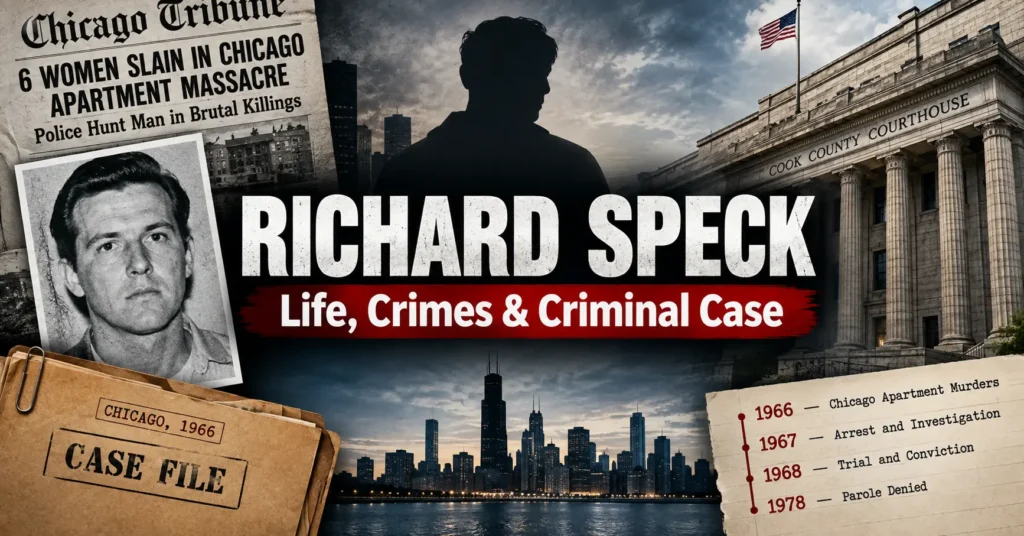
Few American crimes have left a mark on the national memory quite like the one Richard Speck committed on a humid summer night in Chicago in 1966. In a matter of hours, a drifter with a long arrest record ended the lives of eight young student nurses who had done nothing more than come home to the townhouse they shared. The case arrived at a moment when the country was already uneasy, and it helped push a phrase into common use that had rarely been needed before: mass murder.
This article examines the Richard Speck case as a piece of criminal and legal history rather than as a lurid true-crime spectacle. It traces his early life and his escalating record of offenses, outlines what happened in the summer of 1966, follows the investigation and trial that followed, and looks at the strange scientific myth the case generated. It also considers something too often lost in retellings: the eight women whose names deserve to outlast his.
Who Was Richard Speck?
Richard Benjamin Speck was an American drifter, laborer, and merchant seaman who became one of the most notorious criminals of the twentieth century after the July 1966 murders of eight student nurses in Chicago. He was twenty-four at the time. He had no meaningful education past the ninth grade, no steady employment history, and a rap sheet that by then ran to dozens of arrests across two states.
Before that night he was, in law-enforcement terms, an unremarkable repeat offender — the kind of man who cycled through jails for burglary, public drunkenness, and petty theft without ever drawing much attention. What made the case so disturbing to contemporary observers was precisely that ordinariness. There had been no warning sign visible enough for anyone to act on, and nothing about his record predicted the scale of what he would do.
Richard Speck’s Early Life and Background
Speck was born on December 6, 1941, in Kirkwood, Illinois, into a large working-class family. His father, to whom he was reportedly close, died when Speck was six years old. His mother later remarried, and the family relocated to the Dallas, Texas, area. By most accounts the household that followed was unstable, and Speck’s relationship with his stepfather was hostile and at times violent.
His adolescence was defined by drinking, truancy, and trouble with the police. He began consuming alcohol heavily while still in his early teens and dropped out of school without finishing. Arrests accumulated steadily through his late teens and early twenties — a long series of minor and mid-level offenses rather than any single dramatic crime. A brief marriage in the early 1960s produced a daughter and ended in divorce by 1966. At some point during these years he acquired the forearm tattoo reading “Born to Raise Hell,” a detail that would later prove decisive.
The Path to Chicago
By the spring of 1966, Speck had returned to Illinois and was living in Monmouth, working odd jobs. Police there wanted to question him in connection with the burglary and assault of an elderly woman and, separately, the death of a local barmaid named Mary Kay Pierce
He resurfaced in Chicago that summer, staying with relatives and seeking work through the National Maritime Union hiring hall on the city’s Southeast Side. Assignments kept falling through. The union hall sat directly across the street from a row of townhouses used as off-campus housing by student nurses affiliated with South Chicago Community Hospital — a proximity that was, tragically, entirely coincidental.
The Chicago Nurse Murders of July 1966
On the night of July 13 into the early morning of July 14, 1966, Speck entered the townhouse at 2319 East 100th Street in the Jeffery Manor neighborhood. Nine young women were inside or arrived during the course of the night. He bound them and, over several hours, killed eight of them.
One woman survived. Corazon Amurao, a twenty-three-year-old exchange nurse from the Philippines, freed herself from her bindings and remained hidden beneath a bed until morning, when she climbed onto a window ledge and called for help. Her account — calm, precise, and delivered under extraordinary pressure — became the backbone of the entire prosecution. She had studied her attacker closely enough to describe his face, his speech, his clothing, and the tattoo on his arm.
The Investigation, Arrest, and Trial
Chicago police mounted one of the largest manhunts in the city’s history. Amurao’s description, combined with fingerprints recovered inside the townhouse and a witness account from the maritime union hall, allowed investigators to name Speck as the suspect within roughly two days. His photograph ran on front pages and television broadcasts across the country.
The arrest came in an unexpected way. Speck, hiding in a cheap West Madison Street hotel, attempted suicide and was taken to Cook County Hospital. A young resident physician, LeRoy Smith, noticed the tattoo on the patient’s forearm, recalled the widely circulated description, and quietly alerted police. The 1967 trial was moved to Peoria because of the saturation coverage in Chicago. Amurao identified Speck in open court by walking to the defense table and pointing at him.
The Sentence, the Appeals, and Prison
Speck never faced execution. In 1968 the United States Supreme Court decided Witherspoon v. Illinois, which held that prospective jurors could not be excluded simply for expressing general reservations about capital punishment. Illinois resentenced him in 1972 to consecutive terms totaling between four hundred and twelve hundred years, making release effectively impossible.
He spent the remainder of his life at the Stateville Correctional Center in Joliet, working prison jobs and largely avoiding public attention. Speck died of a heart attack on December 5, 1991, one day short of his fiftieth birthday. No family member claimed his remains. Five years later, a smuggled prison videotape showing Speck engaged in drug use and other misconduct behind bars surfaced on Chicago television, triggering a state investigation into corrections practices and a fresh wave of public anger.
The XYY Myth and the Case’s Scientific Afterlife
One of the most consequential legacies of the Richard Speck case had nothing to do with Speck himself. During pretrial proceedings, speculation circulated — amplified by press coverage and by comments attributed to his defense — that he carried an extra Y chromosome, the so-called XYY karyotype then being floated as a biological marker for aggression. The claim spread internationally and helped popularize the notion of a genetically determined “supermale” criminal.
Subsequent chromosome testing established that Speck did not have the XYY configuration at all. By then the idea had taken on a life of its own, and it took years of careful population research to dismantle it. Large-scale studies eventually found no meaningful link between the karyotype and violent behavior. The episode is now taught in criminology and genetics courses as a case study in how a single sensational crime, combined with an untested hypothesis and an eager press, can distort public understanding of science for a generation. The case also influenced practical policing, accelerating the adoption of centralized fingerprint systems and more rigorous protocols for handling eyewitness testimony.
Remembering the Victims
The eight women killed that night were Gloria Jean Davy, Patricia Matusek, Nina Jo Schmale, Pamela Wilkening, Suzanne Farris, Mary Ann Jordan, Merlita Gargullo, and Valentina Pasion. Six were American; Gargullo and Pasion, like the survivor Corazon Amurao, had come from the Philippines to train in the United States. All of them were in their early twenties, studying nursing, and planning careers built around caring for other people.
Their families spent decades watching the man responsible receive the attention that should have belonged to their daughters and sisters. A memorial honoring the eight nurses stands in the Chicago area, and the nursing community has kept their names in circulation through scholarships and commemorations. Corazon Amurao completed her training, married, built a life largely out of public view, and has consistently declined to trade on the ordeal she survived, a quiet dignity that stands in sharp contrast to the notoriety of the man she helped convict.
Conclusion
The Richard Speck case endures in American memory not because of anything remarkable about the man, but because of what the crime revealed and what it changed. It reshaped how Chicago policed a mass casualty investigation, it fed a pseudoscientific theory that took decades to retire, and it intersected with a Supreme Court ruling that altered capital jury selection nationwide. Speck himself lived out an unremarkable quarter-century behind bars and died without a single person willing to claim his body.
What lasts, or ought to, is the other half of the story. A ninth kept her composure through an unimaginable night and then delivered testimony steady enough to close the case. In the accounting of this history, that courage is the part worth carrying forward.