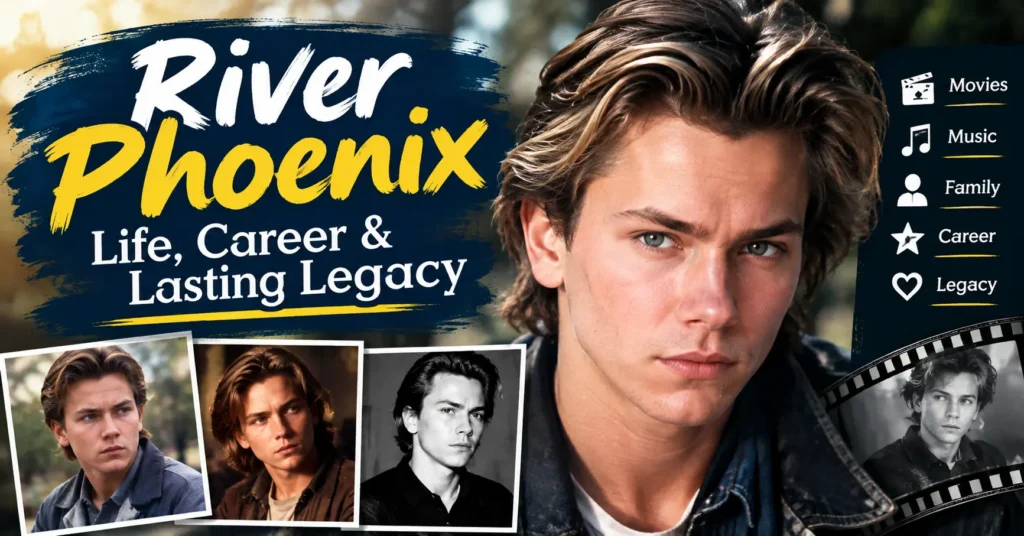
Few actors leave a mark as deep, or as brief, as River Phoenix did. In less than a decade of professional work, he built a body of film performances that critics and audiences still return to, and his name continues to surface in conversations about acting craft, 1980s and 1990s cinema, and the price of early fame. He was barely into his twenties when his career ended, yet the roles he left behind still feel remarkably alive, unhurried, and honest in a way that many veteran performers never quite manage. This article traces his path from a childhood spent traveling with a close-knit, unconventional family to his emergence as one of Hollywood’s most promising young actors, examines the films that defined his career, looks candidly at the personal struggles and public tragedy that ended his life, and considers why his work continues to matter to new generations of viewers.
Who Was River Phoenix?
River Phoenix was an American actor and musician who came to prominence in the mid-1980s as part of a wave of gifted young performers redefining what a teenage or young-adult actor could bring to serious film work. He was known for a naturalistic, understated style that felt closer to real behavior than performance, and for choosing projects that leaned toward complexity rather than easy commercial appeal. Beyond acting, he was an outspoken environmentalist and animal rights advocate, a songwriter and musician, and a young public figure who used his visibility to talk about causes he cared about long before that kind of activism was common among actors his age.
He was also, by most accounts from directors and co-stars, an unusually serious and thoughtful young man, someone who read deeply, questioned scripts, and treated acting less as a career than as a craft worth wrestling with. That seriousness shaped both his best performances and the public’s sense of him as an old soul working inside a young body.
River Phoenix’s Early Life and Family
River Jude Phoenix was born in 1970 in Madras, Oregon, into a family that would soon become known for its unusual, itinerant lifestyle. His parents, John and Arlyn Bottom, were part of a countercultural, spiritually searching generation, and for a period the family was associated with a religious group that sent them traveling through parts of Latin America doing missionary work. The family eventually left the group, changed their surname to Phoenix to symbolize a fresh start, and settled for a time in Florida before moving west toward Los Angeles as the children’s early performing talents became apparent.
Money was often scarce during River’s childhood, and the family supported itself in part by busking and performing on the street, which meant River and his siblings, including his younger sister Rain and younger brother Joaquin, were singing and playing music for audiences before most children their age had performed in a school assembly. That early exposure to live audiences, combined with a home life built around music, storytelling, and unconventional values, gave him a comfort in front of people and a natural expressiveness that talent scouts and casting directors noticed almost immediately once the family reached Los Angeles. He had little formal schooling in the traditional sense, being largely homeschooled and self-taught, which left him with an eclectic, curious intelligence that friends and collaborators frequently remarked on later in his career.
River Phoenix’s Rise as an Actor
River’s break came through television work and commercials in the early 1980s, but it was his film roles later in the decade that established him as something more than a promising child performer. His breakout came with an ensemble coming-of-age film in 1986 that placed him among a cast of young actors playing boys on a journey through the woods, and his performance stood out for its restraint and emotional honesty in a genre that often pushed young actors toward exaggeration.
From there, he moved quickly into more demanding roles, working with directors who saw in him a rare ability to communicate interior thought without relying on dialogue. He was nominated for major industry recognition while still a teenager, playing a young version of a legendary adventurer in a 1989 blockbuster and, in the same period, taking on a wrenching role as a teenage runaway in a smaller, more intimate drama that many critics still consider the finest work of his short career. What distinguished this stretch of his career was his willingness to alternate between big studio projects and smaller, riskier independent films, a pattern that suggested an actor more interested in craft than in simply building box office momentum.
River Phoenix’s Major Films and Performances
The film most often cited as his defining performance is a 1991 independent drama in which he played a narcoleptic hustler on a search for his estranged mother, a role built on long silences, physical vulnerability, and a kind of tenderness rarely seen in stories about street life at the time. The performance earned him major critics’ awards and remains a touchstone for actors and film students studying how stillness and restraint can carry more emotional weight than dramatic outbursts.
His filmography also includes a teenage road-trip drama in which he played opposite two other future stars, a legal thriller in which he brought unexpected depth to a supporting role, and a sequel to the archaeologist-adventurer franchise that introduced audiences to the character in his younger years, a performance so well matched to the franchise’s lead actor that it is still used as an example of thoughtful casting. He also had music running alongside his acting career, writing and performing with a band, which reflected the same instinct for emotional honesty that shaped his screen work. Taken together, his roles reveal an actor drawn again and again to characters who were searching, displaced, or quietly wounded, a thread that feels consistent with the searching, unconventional childhood he had lived through himself.
River Phoenix’s Activism and Personal Life
Long before environmental and animal rights causes became familiar talking points for celebrities, River Phoenix was speaking publicly about them, often at some cost to his commercial image. He followed a vegan diet years before it had wide cultural visibility, used interviews to talk about deforestation and factory farming, and donated time and money to environmental organizations. Friends and family have described this activism as a genuine extension of the values he was raised with, not a public relations exercise, and it shaped how he approached both his personal life and his choice of film projects.
At the same time, the pressures of early fame, an unstable childhood, and the culture of the industry he had grown up inside of took a toll. Those close to him later spoke of a young man who felt the weight of being seen as wise beyond his years, who struggled privately even as his public image remained that of a thoughtful, grounded star. That gap between the poised public figure and the more troubled private reality would become central to how his life is understood today.
River Phoenix’s Death and Its Aftermath
On the night of October 30, 1993, River Phoenix collapsed outside a well-known Los Angeles nightclub and was pronounced dead a short time later, at the age of twenty-three. A toxicology report found a combination of drugs in his system, and the death was ruled the result of acute drug intoxication. The event became one of the most widely reported entertainment stories of the early 1990s, in part because of his age, his reputation as one of the more thoughtful and socially conscious young stars of his generation, and the abruptness with which a rising career came to an end.
In the years since, family members, friends, and biographers have spoken about the pressures that likely contributed to that night, from the demands of sudden fame at a young age to the difficulty of reconciling a public image built around maturity and conscience with private struggles that were not visible to audiences. Rather than reducing his story to a cautionary tale, most serious accounts of his life have tried to hold both truths at once: a genuinely gifted, principled young artist, and a young man who did not receive, or could not access, the support he needed. His death also left an unfinished film project, and the difficult decisions made to complete it without him became their own small chapter in film history.
River Phoenix’s Lasting Literary Legacy
Though his career lasted only about a decade, River Phoenix’s influence on screen acting has proven durable. Actors and directors who came up in the years after his death have pointed to his performances, particularly his work as a young hustler in his most acclaimed film, as a model for how understatement and vulnerability can be more powerful on screen than conventional dramatic technique. Film schools and acting workshops still study his choices, and retrospectives of his work continue to draw new audiences who were not yet born when he was working.
His legacy also lives on through his family, most visibly through his brother Joaquin Phoenix, who has become one of the most respected actors of his own generation and has spoken publicly, with care, about his brother’s influence on his approach to acting and to life. Beyond his immediate family, River Phoenix’s early environmental and animal rights advocacy is now recognized as ahead of its time, a reminder that his public identity was never limited to acting alone. Three decades on, he remains a reference point for conversations about talent cut short, about the particular vulnerabilities of child and teenage fame, and about the kind of screen presence that cannot easily be taught.
Conclusion
River Phoenix’s story resists easy summary. He was a child of an unconventional, searching upbringing who turned that same searching quality into some of the most quietly affecting film performances of his era, and he used his early fame to speak about causes he believed in long before that was fashionable. His death at twenty-three remains a genuine loss, not simply for what it cut short in commercial terms, but for the particular, unrepeatable quality of attention he brought to every role he played. Decades later, audiences discovering his films for the first time tend to arrive at the same conclusion that critics reached while he was alive: that rare, unforced honesty on screen is difficult to teach, and even harder to replace.